Newton
Your way into crypto
Cryptocurrency markets finished the month treading water. Policy uncertainty and renewed trade concerns slowed momentum, prompting a more measured approach across risk-on assets.
At the tail end of January, both the Bank of Canada (BoC) and the U.S. Federal Reserve paused interest rate cuts. In the United States, the policy rate stays in the 3.50 to 3.75 percent range. In Canada, the BoC has maintained its policy interest rate at 2.25 percent, noting that inflation was 2.1 percent in 2025 and expects it to stay close to the two percent target over the projection period, with trade-related cost pressures offset by excess supply.
Trade remained a central theme throughout January. Tariffs continued to shape market expectations with Canada, the United States, and China navigating shifting economic relationships. Trade policy once again functioned as leverage rather than settled structure, adding uncertainty for export-driven sectors and domestic investment. The American president at one point suggested 100% tariffs on Canada if it were to make a trade deal with China. Prime Minister Carney quickly shut down speculation, saying Ottawa was not in free trade talks with Beijing.
Gold and silver remained among the stronger-performing assets. Ongoing trade discussions and geopolitical risks persisted, a backdrop in which both metals have historically been used as hedges during periods of uncertainty.
On the 29th, ARK Invest founder, CEO, and CIO Cathie Wood shared on X that “The market cap of gold as a percentage of the US money supply (M2) hit an all-time high: higher than its peak in 1980 when inflation and interest rates soared to the mid-teens.” She posted this, as well as other historical statistics, to support her opening assertion that odds were high for a gold pullback. The following day, precious metals saw a sharp reversal with gold dropping roughly 8% and silver falling by almost 30%.
While Bitcoin is often cited as digital gold, it shares characteristics associated with both risk-on and risk-off assets, and has not consistently moved in step with metals. For many early Bitcoin holders, its appeal lies in its fixed supply and resistance to monetary debasement, which support its role as a long-term hedge against inflation rather than a short-term safe haven.
This distinction helps explain why Bitcoin can move independently of traditional hedges. Its value is shaped not only by macro conditions, but also by adoption, liquidity, and evolving use cases, which can influence price behaviour differently across market cycles.
Trump has nominated Kevin Warsh to step in as the next head of the Federal Reserve. Bloomberg reported that both Prime Minister Carney and BoC’s governor Tiff Macklem congratulated Warsh on his nomination. When it comes to crypto, Warsh has been quoted as saying he sees Bitcoin as “a good policeman for policy”. For more on the Bitcoin four-year cycle, click here.
This month, you may have noticed a change in our app. For those who didn't try during our beta release, we have updated your Coin Details experience on the web to bring you a more intuitive way to explore each asset. Check your holdings, follow price movements, or place buy and sell market orders without leaving the page.
For a quick demo, watch the update video ▶
The goal of this update is to improve the way coin information is presented in Newton, with clearer layouts and faster access to the tools users reference most, so you can spend less time navigating the app and more time focusing on the market. We hope you enjoy the simplicity and enhanced flow.
If you stake on Newton, you might notice that we removed our $10 minimums this month across all available assets. For users holding Ethereum, Solana, Cardano, Cosmo, Polkadot, NEAR, or Sui that are curious about earning yield, you can learn more about available staking opportunities here.
We wanted to take a closer look at order execution decisions, so we took to Bay Street and asked traders how they actually place orders. For those we spoke to, the choice came down to three things: timing, order size, and how much certainty they wanted at that moment. The full blog was part one of our series on orders and is linked here.
Since 2023, we have partnered with Koinly during the tax season, so keep an eye out for our annual discount code from Koinly that is expected to be released toward the end of this month. Koinly is a software platform designed to help users calculate and report taxes on their crypto asset transactions. It allows you to import transactions from supported platforms, as well as external wallets and exchanges.
Bear markets do not just drain prices; they also drain investor confidence, making inaction at times feel safer than action. This is not a personal failing, but rather a natural response to uncertainty.
Dollar-cost averaging is an approach that involves investing fixed amounts at regular intervals, regardless of short-term price movements. By investing at regular intervals, dollar-cost averaging spreads decisions over time. It removes the pressure of choosing the “right” moment and replaces it with a repeatable process that does not require constant judgment calls.
A six-year stretch helps illustrate the point. Over that period, our hypothetical investor Jane contributed $20 every two weeks to Bitcoin and Ethereum while experiencing multiple market cycles, including sharp drawdowns and periods of recovery.
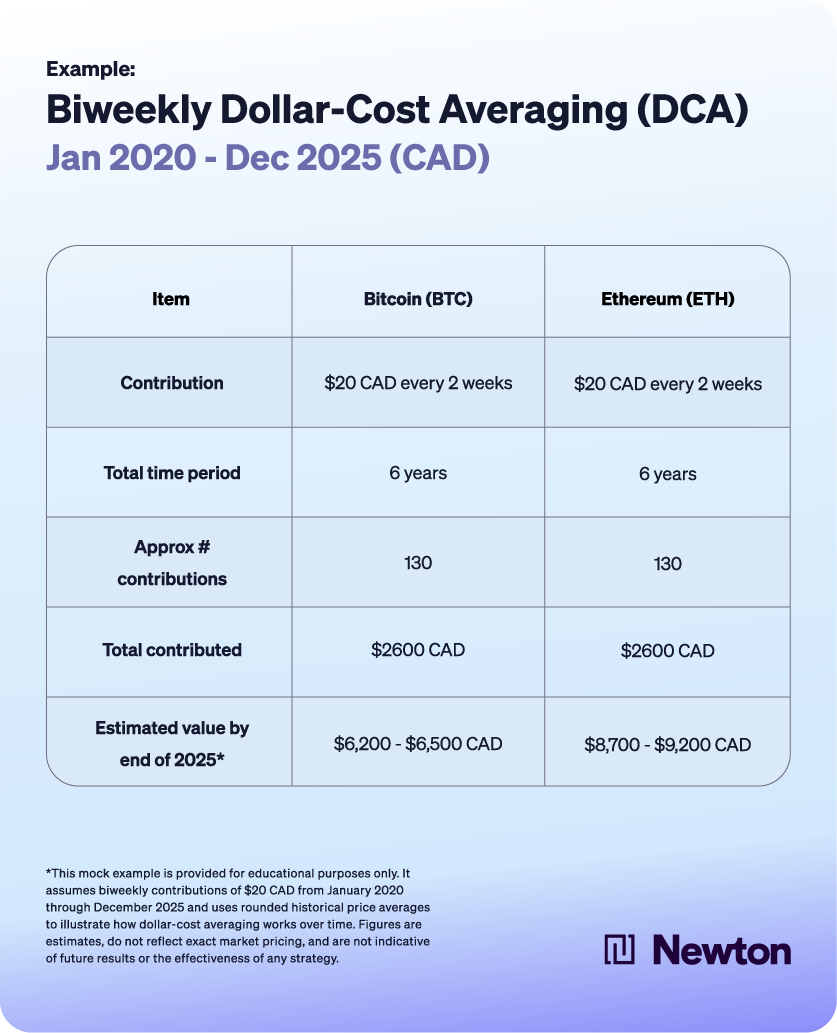
Different start dates, contribution periods, or asset selections could have produced materially different outcomes, including lower or negative results. This illustration is intended to show how contributions may be distributed across market conditions, not to demonstrate performance.
Dollar-cost averaging cannot make markets predictable or reduce market volatility. For some investors, the approach can take some of the weight off individual decisions.
This month’s Gravity Gauge reflected a market that moved in two directions at once, with select tokens finding lift while several majors drifted lower, reinforcing how much outcomes depended on positioning rather than broad momentum.
⬆️ Render (RNDR) closed up about 20.67 percent.
⬆️ Polygon (POL) also finished up roughly 3.08 percent.
⬇️ Uniswap (UNI) dipped about 29.78 percent.
⬇️ Ethereum (ETH) slipped about 17.52 percent.
⬇️ Bitcoin (BTC) eased about 10.17 percent over the month.
⬇️ Solana (SOL) finished down approximately 15.30 percent.
⬇️ Worldcoin (WLD) declined roughly 13.92 percent.
Prices reflect beginning-of-month opening and end-of-month closing levels.
Whether you are new to crypto or have been in the space for years, Newton’s blog offers resources for everyone. Our learning content is designed to be beginner-friendly without skipping the deeper ideas, because we believe the future of finance should be understood. In next month’s BYTE, we will continue tracking how crypto, markets, and policy are taking shape.




.png)