
Read in 4 minutes | July 2026
July’s economic data pointed in a better direction, but the improvement was not felt equally.
Canada's headline inflation rate declined, economic growth appeared to strengthen, and crypto recovered from some of June's losses. At the same time, grocery prices continued rising faster than the broader cost of living, the crypto rebound weakened before month-end, and central banks remained cautious about what comes next.
Today's BYTE: cooling inflation, stubborn grocery costs, an uneven economic recovery, and a crypto rebound that weakened before month-end.
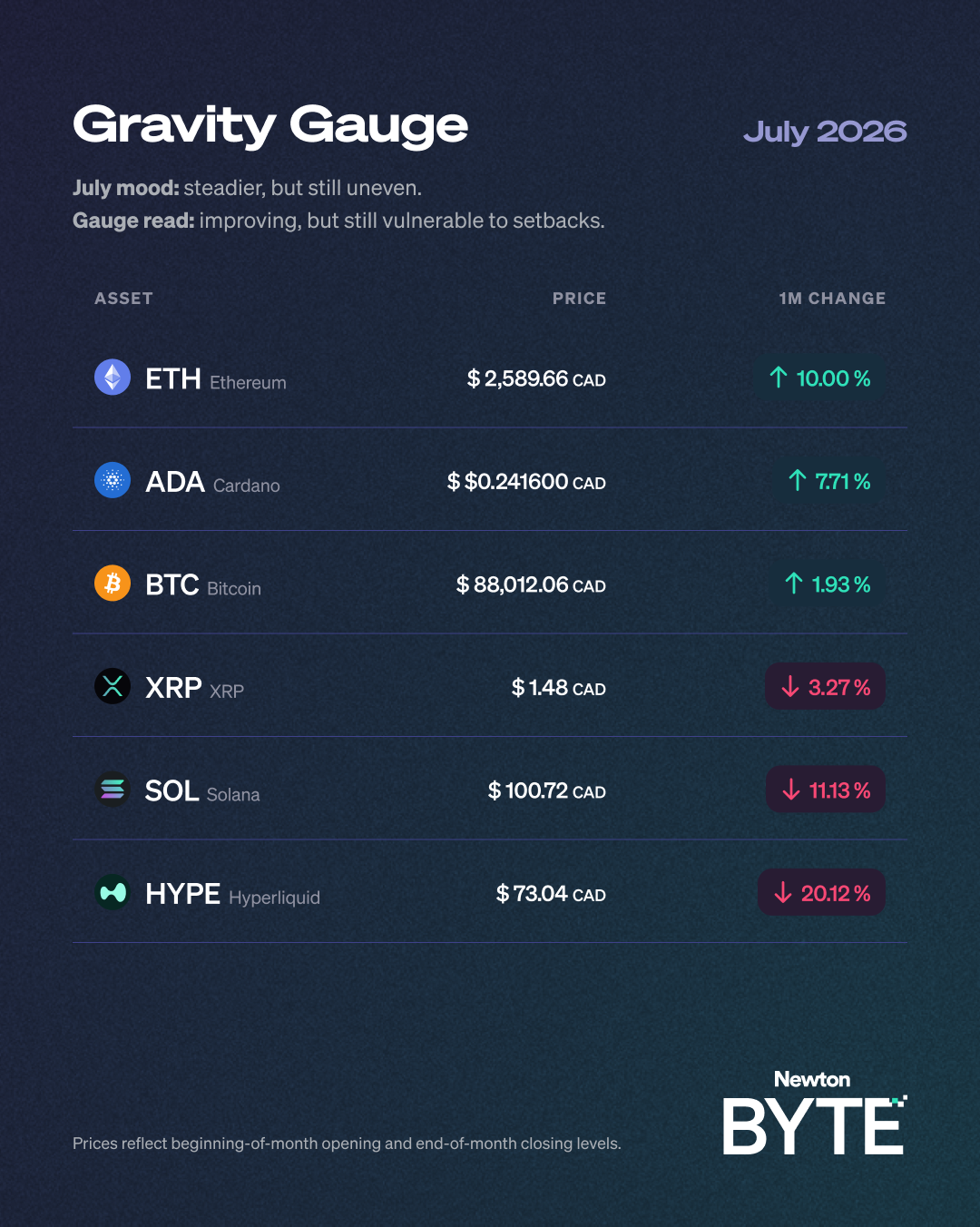
July mood: steadier, but still uneven.
Bitcoin climbed to its highest level in about a month, while Canadian economic data showed further signs of improvement. Neither marked a decisive turning point, with the outlook still sensitive to ETF flows, interest rates, trade policy, and geopolitical risk.
Gauge read: improving, but still vulnerable to setbacks.

Inflation cooled, but groceries told a different story.
Statistics Canada reported that the Consumer Price Index rose 2.8% year over year in June, down from 3.2% in May. Slower gasoline price growth drove much of the decline, while inflation excluding gasoline held at 2.2%. On a monthly basis, CPI fell 0.4% (not seasonally adjusted), or 0.1% on a seasonally adjusted basis.
The improvement was less visible at the grocery store, where food purchased from stores rose 3.9% year over year, continuing to outpace Canada's overall inflation rate. That gap helps explain why easing headline inflation may not immediately feel like lower costs in Canadians' day-to-day lives.
Canada’s recovery became more visible, but remained uneven.
On July 15, the Bank of Canada estimated second-quarter economic growth at an annualized pace of approximately 2.5%, following a weak start to the year. In a separate preliminary release later in the month, industry data indicated the economy expanded 0.8% quarter over quarter. The official expenditure-based estimate is scheduled for August 28.
Consumer spending remained solid, exports resumed growing, and housing activity showed signs of stabilizing. The Bank also pointed to booming investment in artificial intelligence as an important driver of growth south of the border. Still, the broader outlook stayed cautious: the Bank expects Canada's economy to grow only 0.7% in 2026, with U.S. tariffs, slower population growth and geopolitical uncertainty weighing on the outlook. Higher energy prices remained a mixed factor, adding to inflation and squeezing household budgets while also supporting Canadian energy exports and investment.
Central banks stayed on hold.
The Bank of Canada kept its overnight rate at 2.25% on July 15, saying economic conditions were beginning to improve, but uncertainty remained high, particularly around U.S. trade policy and the conflict in the Middle East. Its next scheduled decision is September 2. The U.S. Federal Reserve also held its target rate at 3.5% to 3.75% on July 29, in a 9–3 vote, with three officials preferring a quarter-point increase and the Fed noting inflation remained elevated relative to its 2% goal. Both banks stayed put, but the split Fed vote showed policymakers disagreed over the appropriate setting.
Crypto bounced, then gave back some of its gains.
Bitcoin moved above CAD$93,000 in July before retreating below CAD$89,000 near month-end. U.S. spot Bitcoin ETFs recorded several consecutive days of inflows during the recovery, although flows became more mixed again late in the month.

17 months
Grocery price growth outpaced Canada’s overall inflation rate for the 17th consecutive month.
Food purchased from stores rose 3.9% year over year in June, compared with the headline CPI increase of 2.8%. Grocery inflation slowed from May but continued to run hotter than the broader cost of living.
The figure captures one of July's biggest economic tensions: inflation was cooling on paper, but some of the most frequent household expenses were still rising faster.
July produced more encouraging economic signals than June, but not a complete change in direction.
Canada's recovery appeared to strengthen, headline inflation declined, and crypto regained some stability. Grocery costs remained elevated, market confidence was fragile, and central banks continued waiting for clearer evidence before changing course.
August will provide another test of whether this progress is gaining traction or simply offering a pause between setbacks.



.png)
.png)