Sign-up to get started
Get onboarded and start trading with as little as $50.



This page provides information about the asset. It is not available for trading on Newton.
Kyber Network Crystal (KNC) is the native token of the Kyber Network, which operates as a decentralized exchange and liquidity protocol on the Ethereum blockchain. KNC plays a key role in the governance of the network and is used to pay transaction fees on decentralized applications (dApps) that are powered by the Kyber Network. The token also incentivizes liquidity providers and rewards them with KNC tokens in exchange for contributing to liquidity pools.
This coin is not available on Newton.
KNC holders can participate in the KyberDAO, where they can stake their tokens and vote on important governance decisions. This decentralized governance model allows the Kyber community to shape the future of the network by making decisions on updates and protocol changes. Additionally, staking KNC provides holders with staking rewards, which come from trading fees generated by the decentralized exchange.
Kyber Network is known for aggregating liquidity from various sources to provide secure and instant transactions on any decentralized application. This is made possible through Kyber's dynamic market maker (DMM) and liquidity pools that offer some of the best rates for token swaps. The network serves as a multi-chain hub of liquidity protocols, offering enhanced liquidity for DeFi applications.
The price of Kyber Network Crystal (KNC) fluctuates based on supply and demand within the crypto market. Users can check the live price or historical price of KNC on various crypto exchanges. KNC tokens are ERC-20 tokens, which makes them compatible with Ethereum-based wallets and decentralized exchanges.
As of the latest crypto data, the price of KNC is subject to change due to market movement. Those interested in trading or buying Kyber Network Crystal (KNC) can find it on various cryptocurrency platforms and exchanges. Additionally, the Kyber Network has a total supply of 223.36 Million KNC tokens, with a portion of those coins that have been burned over time, affecting the price history and overall market dynamics.
Kyber Network is a multi-chain hub that aggregates liquidity from various liquidity providers, including holders who can stake their tokens in the KyberDAO. This aggregation allows for the efficient exchange of digital assets across different networks. Users can trade Kyber Network Crystal (KNC) tokens on the network, taking advantage of liquidity pools that provide competitive rates based on current market conditions. By connecting various stakeholders in Kyber’s ecosystem, including liquidity providers and KNC token holders, Kyber Network enables users to access a wide range of tokens in the crypto market.
The Kyber Network Crystal (KNC) token is used as the native asset for transactions, and users can buy KNC or trade KNC for other tokens directly on the network. KNC trading is facilitated by liquidity pools designed to provide users with competitive rates for token swaps. These liquidity pools are secured by the Ethereum blockchain and allow developers to build products and services that interact with various decentralized finance (DeFi) protocols. The network’s aggregator continuously compares liquidity pools to provide users with some of the best available rates based on the market price.
In the Kyber ecosystem, KNC token holders can receive rewards in KNC that come from trading fees on the Kyber Network. These fees, along with staking rewards in KNC, provide an incentive for liquidity providers to participate in the network. These rewards help maintain the liquidity necessary for the smooth operation of the platform and encourage further participation. Additionally, KNC token holders can stake their tokens in KyberDAO, contributing to the decision-making process and governance of the network.
Traders can easily verify the Kyber Network Crystal price chart to track price movement over the last 24 hours. The network’s transparent structure allows users to monitor KNC’s performance in the crypto market and identify trends. As with any digital asset, the price of KNC can fluctuate based on market conditions, with liquidity pools providing competitive rates for those looking to trade. These fluctuations reflect the dynamic nature of the crypto market and present opportunities for traders to take advantage of favorable price movements.
Kyber Network continues to develop and expand its capabilities, offering a robust infrastructure for users to trade and engage with cryptocurrencies. Developers are encouraged to build on the network, contributing to the growing ecosystem of liquidity protocols that aggregate liquidity and provide competitive rates. With its multi-chain capabilities and integration with decentralized exchanges, Kyber Network is positioned as a powerful tool for anyone looking to trade KNC or other tokens in the crypto space.
Kyber Network Crystal (KNC) plays a key role in providing liquidity and supporting decentralized finance (DeFi) applications. Here's how it functions:
Buying Kyber Network Crystal (KNC) is simple through various cryptocurrency exchanges and platforms. Here's how you can buy it:
Tracking the historical price of Kyber Network Crystal (KNC) is easy through several platforms. Here’s where to find it:
Kyber Network Crystal (KNC) is an ERC-20 token that operates within the Ethereum ecosystem to facilitate decentralized liquidity. Here's how it works:
Kyber Network Crystal v2 (KNC) plays an important role in the governance and growth of Kyber Network's ecosystem. Different stakeholders in Kyber's ecosystem, such as token holders, developers, and liquidity providers, can participate in decentralized decision-making through KyberDAO. By voting on protocol upgrades and other essential proposals, they help guide the network's development and success.
KNC can be used to earn rewards through staking, providing an alternative to traditional savings. By staking their tokens in a crypto wallet, users receive KNC as an incentive for supporting the network’s security and liquidity. This process encourages long-term participation while contributing to the overall stability of the Kyber Network ecosystem.
The Kyber Network is also designed to enhance liquidity provision, particularly through Kyber DMM (Dynamic Market Maker), which aggregates liquidity from various sources. This process allows traders to access a deeper pool of liquidity, reducing price slippage and facilitating efficient asset trading. As a result, users can find KNC more easily and trade with minimal disruption to crypto prices.
Through decentralized exchanges, such as KyberSwap, KNC holders can participate in decentralized trading without intermediaries. This removes many of the risks associated with centralized platforms, such as security breaches or the need for extensive Know-Your-Customer (KYC) processes. Users can exchange assets directly from their crypto wallet in a secure, permissionless environment, giving them full control over their digital assets.
KNC also facilitates cross-chain asset swaps, helping users move their digital assets across different blockchain networks. This increases interoperability and creates more opportunities for DeFi participation. As the Kyber Network ecosystem continues to grow, KNC’s role in enabling these seamless transactions will likely become more significant, benefiting both users and the Kyber team.
Kyber Network Crystal (KNC) was created by the Kyber Network team, which was founded in 2017 by Loi Luu, Victor Tran, and Yaron Velner. Loi Luu, a former researcher at the University of California, Berkeley, had a vision to solve liquidity problems in the decentralized finance (DeFi) space. Together with his team, they launched Kyber Network as a decentralized liquidity protocol aimed at aggregating liquidity from various sources to provide real-time, on-chain pricing for decentralized applications.
KNC was introduced as an ERC-20 token to support the Kyber Network ecosystem. It was designed to be used for transaction fees, governance, and rewarding liquidity providers. Over time, KNC became a key element of the network's decentralized governance model, KyberDAO, where token holders could vote on important decisions such as protocol upgrades and fee structures. This transformation allowed the community to have a direct influence on the network’s direction and growth.
In 2020, the Kyber Network underwent a significant upgrade with the launch of KyberDAO and the introduction of Kyber Network Crystal v2 (KNC). This upgrade enhanced governance flexibility and introduced staking features, allowing KNC holders to stake their tokens and earn rewards for helping secure the network. The upgrade marked a pivotal moment in Kyber's growth and its transition into a more robust DeFi ecosystem.
As the Kyber Network evolved, KNC became increasingly important for liquidity provision through KyberSwap, the decentralized exchange built on the Kyber protocol. KNC helped aggregate liquidity from multiple sources, allowing for efficient and low-cost trading. This solidified KNC's role as a cornerstone of the Kyber Network ecosystem, contributing to its scalability and functionality.
Today, KNC continues to evolve as part of Kyber Network's ongoing expansion in the DeFi space. The token plays a crucial role in governance, staking, and liquidity provision, while the introduction of new features like cross-chain swaps enhances its functionality. The leadership and vision of founders Loi Luu, Victor Tran, and Yaron Velner have been key to Kyber's continued success and relevance in the decentralized finance world.
Kyber Network Crystal (KNC) plays a significant role in the decentralized finance (DeFi) ecosystem. Here's how it contributes:
The price of Kyber Network Crystal (KNC) fluctuates regularly. Here's how to keep track:
Trading Kyber Network Crystal (KNC) in Canada is simple through supported platforms. Here's how you can trade KNC:
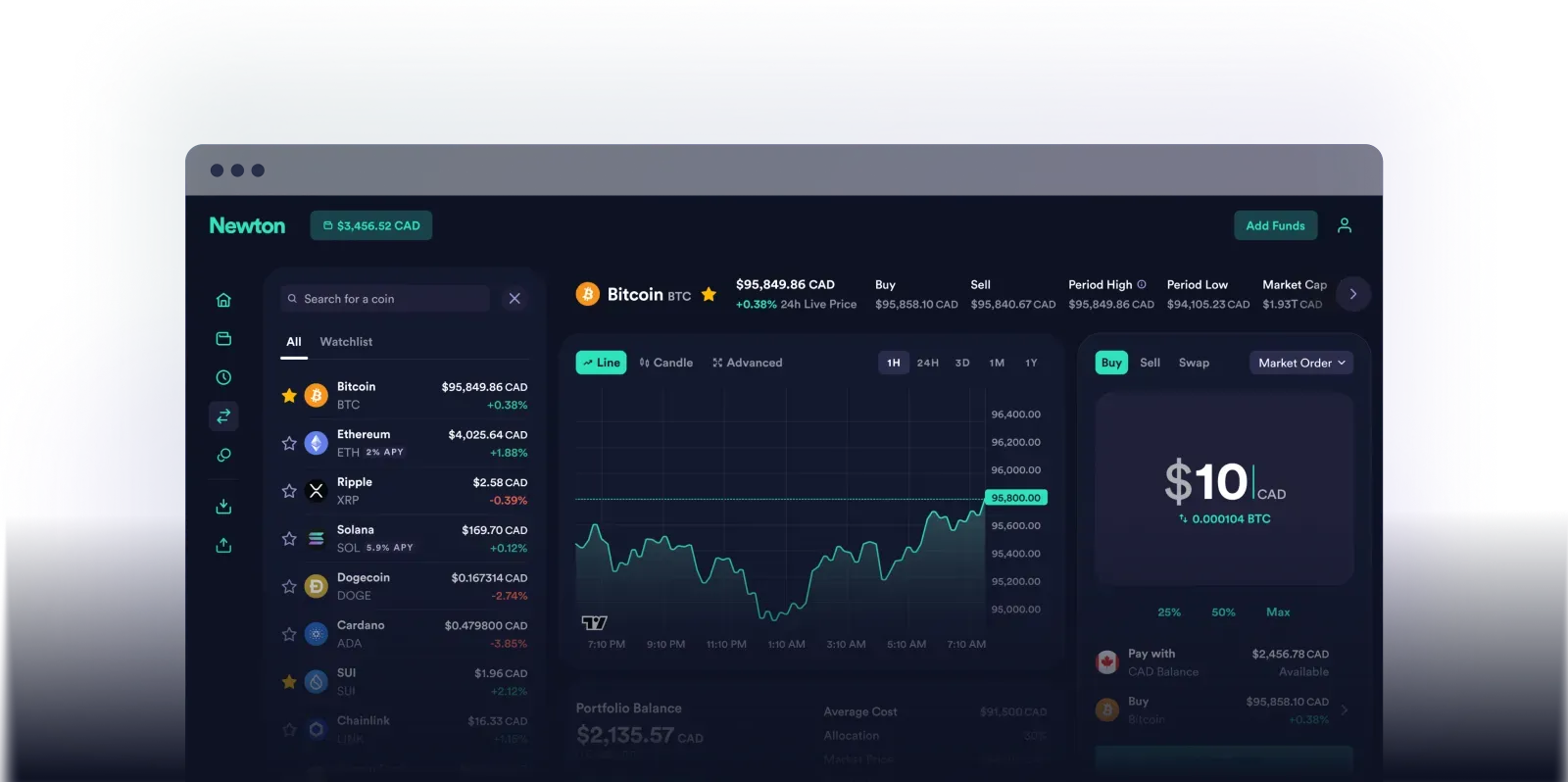
Your security is important. Newton is committed to being a leader in compliance, security, and technical protocols.
For additional information and to review the risks associated with Kyber Network Crystal, please see our Asset Statement.